
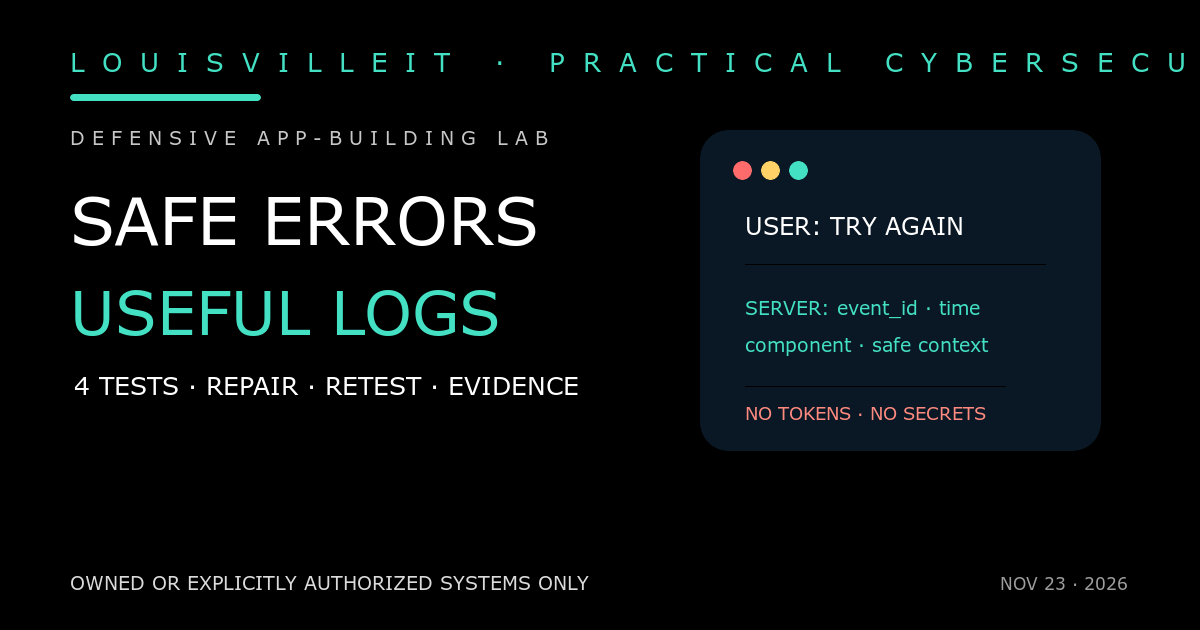
A useful error for a user and a useful diagnostic for a developer should not be the same output. OWASP warns that improper error handling can reveal implementation details, while its guidance favors a generic response for unexpected errors and detailed logging on the server side.
This lab is defensive. Use it only on an application, account, device, or environment you own or are explicitly authorized to test. Use a non-production environment or an isolated learning lab. Never paste real secrets, private logs, customer data, or production configuration into public AI tools.
The four tests
- Unexpected-input test: Send a harmless invalid value through a normal input path. The user response should be clear but should not reveal a stack trace, framework version, file path, database detail, or internal identifier.
- Missing-resource test: Request a harmless non-existent record in the authorized test environment. The external response should not expose internal storage or query details.
- Dependency-failure test: In the isolated environment, simulate an unavailable test dependency through a supported development control. The client should receive a bounded error while the server captures enough context to diagnose the failure.
- Log-safety test: Inspect the authorized server-side record. It should support diagnosis without storing passwords, tokens, full payment data, private prompts, or unnecessary personal information.
Pass criteria
- Client: a stable, generic, useful message and appropriate status behavior.
- Server: timestamp, controlled correlation identifier, component, event class, and enough bounded context to reproduce the issue.
- Privacy: no secret, sensitive configuration, or unnecessary personal data in either surface.
- Operations: repeated server errors can be monitored and routed to an authorized owner.
Use AI without leaking the system
AI can help classify a sanitized error pattern, propose a local test, or draft a generic user message. First remove credentials, tokens, hostnames, private paths, customer content, source code that is not yours to share, and exact configuration. If the safe abstraction is not enough, keep the analysis inside an approved private environment or do not use the AI service for that record.
Repair, retest, preserve evidence
- Replace implementation detail in the client response with a bounded message.
- Move diagnostic detail into access-controlled server logging.
- Redact or exclude secrets and unnecessary personal data.
- Repeat all four tests.
- Preserve the test date, environment, expected result, observed result, repair, and retest outcome.
The evidence is not “the request failed.” The evidence is that the client stayed safe, the authorized log remained useful, secrets stayed out, and the repaired behavior passed the retest.