
Louisville Institute of Technology · Student builders
Big ideas start small.
Then someone builds.
Meet Jayden, Skylar, and Dylan. Explore the games, learning tools, and stories they are bringing to life—with curiosity, persistence, and AI as a tool.
Build your first app A real moment of building
01 / Builder & author
Jayden Tran
Age 12One curious mind.
Many ways to create.
From neighborhood businesses to number worlds, Jayden turns ideas into experiences people can try. His growing portfolio includes five apps and his debut novel, The Boy the Fire Forgot: Cinderfall.
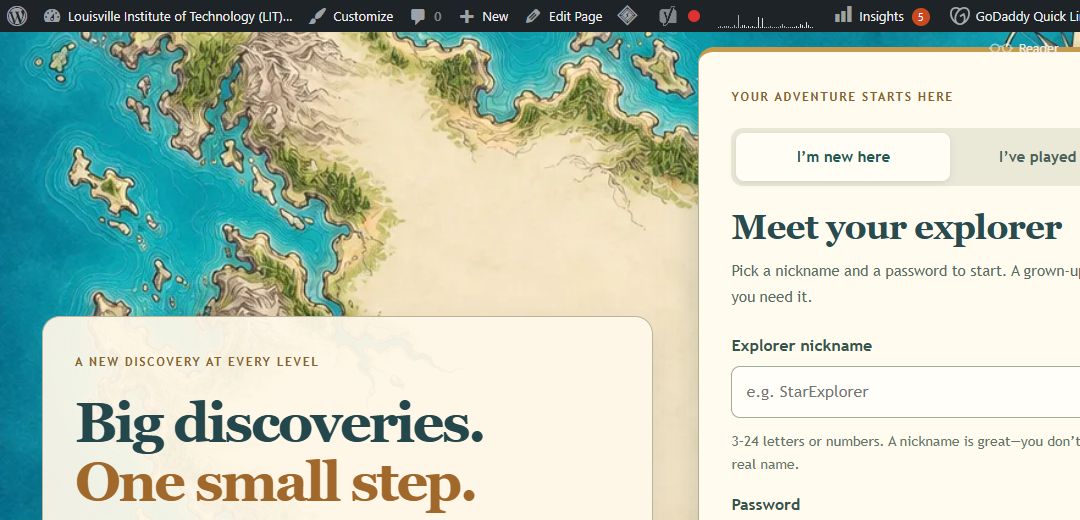
Inside the app · Actual screenshot
Math Adventure
Start with a small discovery. Explore sixteen worlds of mathematics at your own pace.
Open Math Adventure Browser-local explorer profile · Progress stays on this deviceHow AI helped this build
Jayden shapes ideas, tests experiences, and improves his projects. AI assists development, with family guidance; the portfolio does not claim unaided coding.
Student-led ideas, testing, and iteration, with AI-assisted development and family guidance. Each project continues to evolve.
 Curiosity in action
02 / Game builder
Skylar Tran
Age 11Make learning an adventure.
Skylar’s AI Adventure combines quizzes, exploration, and dungeon challenges. His process is simple: build something, try it, notice what needs work, and improve it.
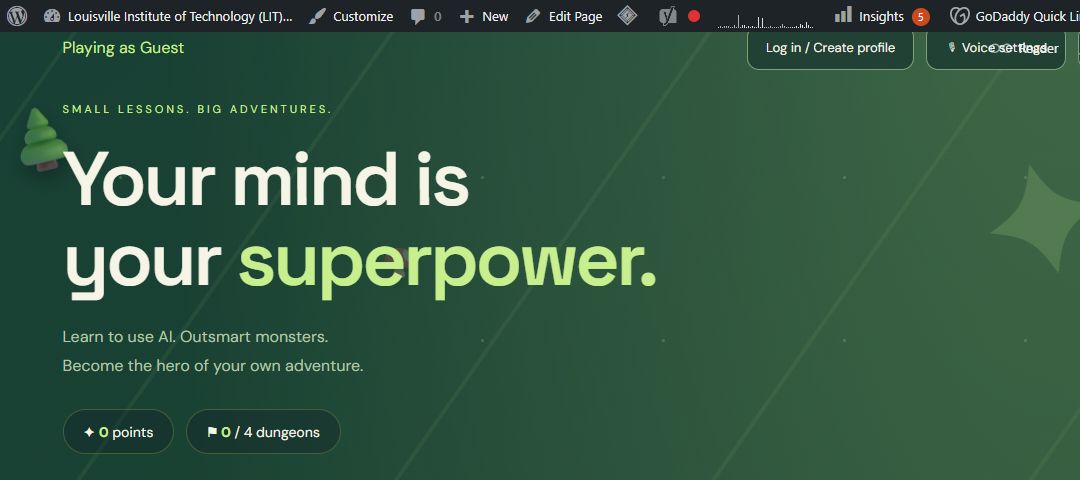
Inside the app · Actual screenshot
AI Adventure
Learn to ask clearly, check facts, and protect privacy through quests and dungeon challenges.
Explore AI Adventure Guest play available · Progress stays on this deviceHow AI helped this build
Skylar directs the game concept and critiques quizzes, controls, and visual feedback. AI assists implementation; family support and repeated testing are part of the process.
An evolving student project, created with AI tools and family support. Play, explore, and see what you might build next.

03 / Game builder
Dylan Tran
Age 9A first app. A big leap forward.
Dylan brought a familiar childhood idea to the screen: the floor is lava. His first published game invites you to jump, explore, and keep trying.
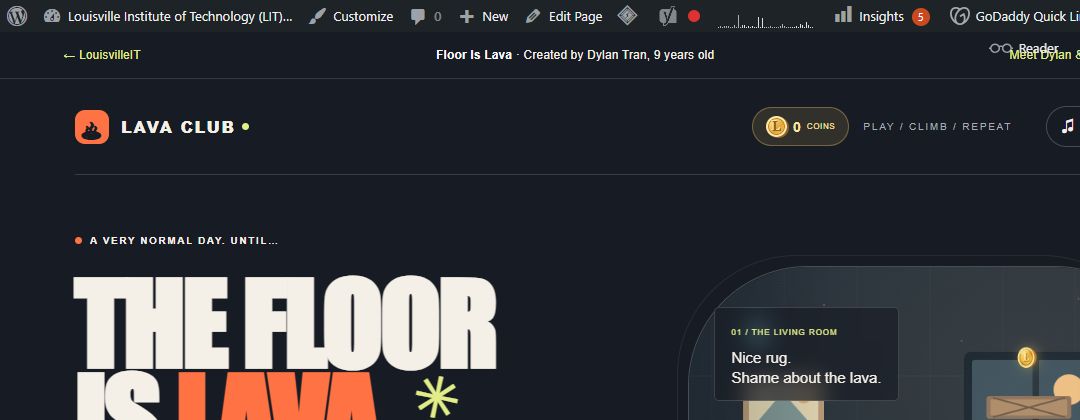
Inside the app · Actual screenshot
Floor Is Lava
An ordinary room becomes an adventure. Choose a mode, make the leap, and keep climbing.
Play Floor Is Lava No download needed · Six game modes to exploreHow AI helped this build
Dylan directs the idea and tests the experience. AI assists coding, with family guidance. The game continues to improve through practice.
Dylan directs the idea and tests the experience, with AI-assisted coding and family guidance.
Your turn to begin
You do not need a perfect first idea.
Try the coding challenge below. Then plan something for a person you care about.
Jayden and Skylar’s images are background-removed edits of original family-provided photographs. Dylan’s portrait is AI-assisted. Projects are student learning work and may change as their creators improve them.
Your idea.
Your first app.
Jayden, Skylar, and Dylan Tran are turning their curiosity into games and learning apps—with AI helping bring their ideas to life. Now it’s your turn. Kids, parents, and adults: start with something you wish existed.
Plan my first app Play Signal Rover ↓ Explore all seven apps ↑Explore Skylar’s AI Adventure ↓You bring the imagination. AI can help with the code. You stay the creator.
Signal Rover
Guide the robot to the gold beacon ✦. Each command moves one square. Test a simulated AI suggestion, find the bug, and write a route that works.
🤖 Rover ▲ Crater ✦ Beacon
Your commands
Design your own mission
Jayden built a neighborhood for Corner Street. What world would you build? Start with one path. Tap a starting square, then neighboring squares to draw a trail. Your last square becomes the beacon.
Choose your own world: a firefly finding its tree, a submarine avoiding reefs, or something only you would imagine. Change the prompt and see what you can build.
STAY CURIOUS · KEEP BUILDING
Your next idea starts here.
Get new student-built apps, practical AI learning ideas, and LouisvilleIT updates in your inbox.
Free updates for adults, parents, and educators. Young makers: ask a parent or guardian to subscribe.
Check your inbox to confirm. Unsubscribe anytime. Questions? DiTranUniversity@gmail.com
A build-first mindset for adults
Learn from kids: begin with what you want to make.
Kids often ask: What could this do? Who would it help? Adults can ask the same questions. AI is a tool, not the destination. Make a small version, test it with a real person, and improve it.
Imagine
Pick one real person and one useful problem. Sketch what success would look like, in plain language.
Make
Use AI and approachable tools to create a first working version. Learn the code and concepts as they become useful.
Check
Try it with care. Fix what breaks. Protect privacy, credit the maker, and keep human judgment in charge.
Coding still matters. It is no longer the gate you must pass through before you can begin building.
Try it now · Free interactive exercise
Make a first-app plan in 60 seconds.
You do not need to know what AI means to have an idea worth building. Name one person and one thing you want to help them do. This little tool turns that thought into a practical first step.
Inspired by the way kids begin: imagine it, make a tiny version, then see if it works.
YOUR FIRST-APP BRIEF · 02 / 02
Start small. Make it work.
Ready to turn the brief into a working project? Ask LouisvilleIT about a build-first path →
This exercise runs in your browser. Nothing you type here is sent or saved. It is a guided planning tool, not an AI-generated app.
Choose your starting point
For every age. For your next “I made that.”
Children often learn by making before they know the vocabulary. Adults can learn from that instinct—not by skipping care or craft, but by starting small, testing honestly, and improving what they build. Young makers are welcome here too.
Make your first app idea real.
Bring a problem you care about. Shape a one-screen first version, then learn what to ask AI, what to test, and where your own judgment matters.
Try the free App Starter →Young makers & familiesSee what a student made.
Explore the live Typing Lab created by Jayden Tran, 12 years old. It shows the spirit we value: make something useful, share it, and keep improving it.
Open the Typing Lab →For deeper studyThe 100-day builder journey.
Ready to go further? Explore LouisvilleIT’s structured AI systems course, with practical assignments and human review.
Explore the course →Ask us about current offerings, age-appropriate supervision, and course details. These examples are educational; no admission or outcome is guaranteed.
The 100-day journey
From curious beginner to capable AI systems builder.
Ten focused stages. Every stage ends with something you can explain, demonstrate, and improve.
Programs are educational and developmental. LouisvilleIT emphasizes skill-building, responsible use, documentation, and demonstrated work; it does not promise employment, income, admissions decisions, recognition, or technology outcomes.
Kentucky-built proof
Technology becomes valuable when it serves people.
LouisvilleIT grows from real workforce education and real organizational operations—not theory alone. Students study AI where communication, documentation, compliance, accessibility, and human care all matter.
Our institutional standard
- Implementation before hype
- Documentation before unsupported claims
- Human dignity before automation theater
- Architecture before random prompting
- Workforce value before technology for its own sake
A connected learning ecosystem
Education, workforce, research, and public trust.
LouisvilleIT is strengthened by a founder-built network that connects responsible technology with practical human service.
Your next step
Build something useful with AI.
Tell us what you want to learn, improve, or implement. We will help you find the right pathway.
The LouisvilleIT Journal
Ideas worth building on.
Meet the makers. Explore the research. Find practical ideas for your next step in technology.
- Before AI Changes Access Control: Run Four Negative Tests
 Ask AI to propose authorization logic only inside systems you own or are authorized to test. Then prove denial for unauthenticated, wrong-owner, lower-role, and revoked-session cases before release.
- Use Technology to Learn: Free Courses, Read-Aloud Options and Evidence of Progress
 A phone or computer can become a practical study tool. These local learning libraries connect guided content, practice and useful projects with a simple goal: understand something better and use it responsibly.
- Before You Share Logs With AI: A Seven-Field Redaction and Evidence Card
 Logs can help authorized AI-assisted troubleshooting, but raw events may contain secrets, identifiers, private content, or unsafe control characters. This seven-field card minimizes, sanitizes, tests, and records the share.
- A Vulnerability Match Is Not Exploitability Proof: Six Fields Before You Patch
 A scanner or CVE name is a lead, not complete proof that one application is affected or exploitable. Use six fields to validate scope, prioritize repair, retest, and preserve evidence.
- Before AI Adds a Dependency: A Six-Field Package Gate
 AI-generated code can introduce packages faster than teams can review them. This defensive six-field gate records identity, source, version, license, vulnerability evidence, purpose, removal plan, and retest before merge.
- AI Training-Use Opt-Out: Build an Evidence Card Before Uploading Data
 An AI service’s training-use control is one data-governance field, not a complete privacy guarantee. This evidence card records the exact account, policy, setting, owner, proof date, and recheck trigger before authorized use.
Fresh perspectives on student creativity, responsible AI, and technology that serves people.