Ten Years of Building Trust: Human Accountability in Technology
A tool can produce an answer. A person remains responsible for checking it.

Louisville Institute of Technology (LIT) – Louisville, KY
Louisville Institute of Technology builds practical AI, automation, cybersecurity, and workforce technology learning through real implementation and human-centered systems.
A tool can produce an answer. A person remains responsible for checking it.
If a credential enters an AI tool or other unauthorized surface, deleting the prompt or restarting a service is not enough. Revoke, rotate, repair dependencies, retest, and preserve evidence.
Before sending logs or records to an AI service, reproduce the authorized problem with the smallest synthetic sample that preserves behavior—not real people, customers, credentials, or production configuration.
AI-assisted debugging should start with a minimum-necessary, redacted evidence bundle. This seven-field method keeps secrets, personal data, customer identifiers, internal configuration, retention, and human review visible.
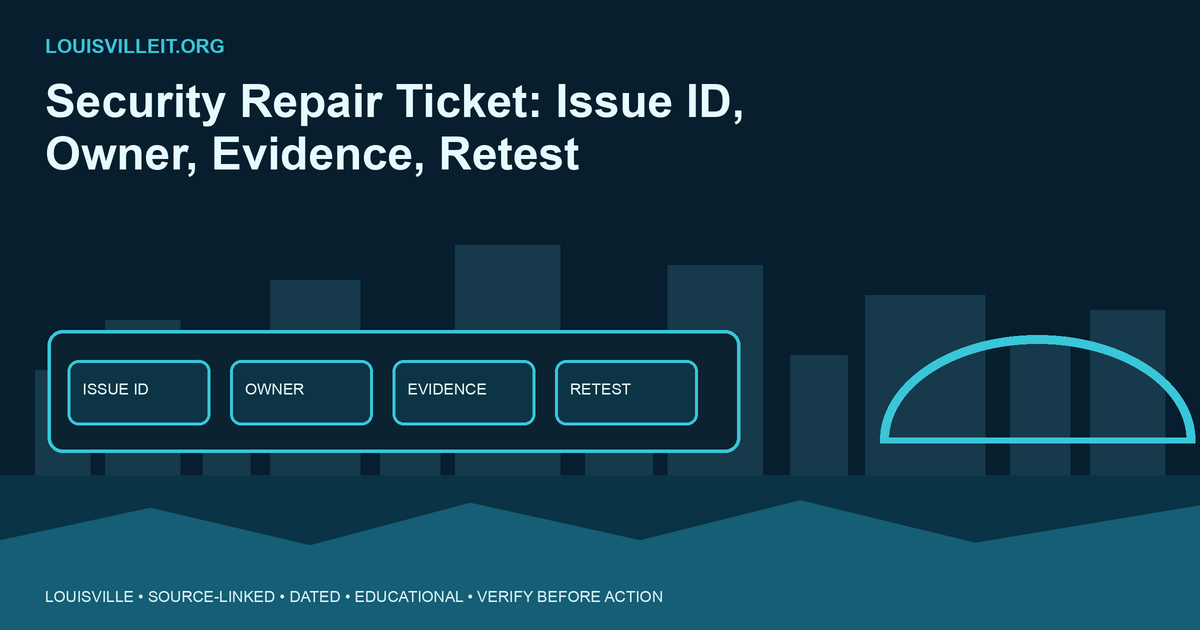
A security finding becomes actionable when it has a stable issue ID, an accountable owner, reproducible evidence, and a defined repair-and-retest result. Use only on systems you own or are authorized to test.
An AI-assisted code finding is not yet an accepted defect, and an accepted defect is not yet a verified repair. Keep proposal, human decision, patch, and retest evidence separate.
AI-assisted code review can expose secrets or private records when the test fixture is careless. This defensive method uses synthetic data, human authorization, scoped review, repair, retest, and evidence.
A backup is more useful when an authorized owner can restore and verify it. This defensive drill uses synthetic data, a separate restore location, and a six-field evidence log.
Remote help should be time-bounded, owner-approved, observable, and closed with evidence. This defensive four-stage test keeps credentials, private logs, and unnecessary access out of the workflow.
Account recovery should be tested before a crisis—only on accounts you own or are authorized to manage. This defensive drill uses non-secret evidence and NIST’s current recovery concepts.