
Direct sources. Clear status. Practical public information.
Reviewed November 12, 2026 · defensive incident response.
Authorization boundary: use this only for accounts, applications, devices, data, and networks you own or are explicitly authorized to administer. Never place the exposed secret itself in the ticket, public copy, or another AI tool.
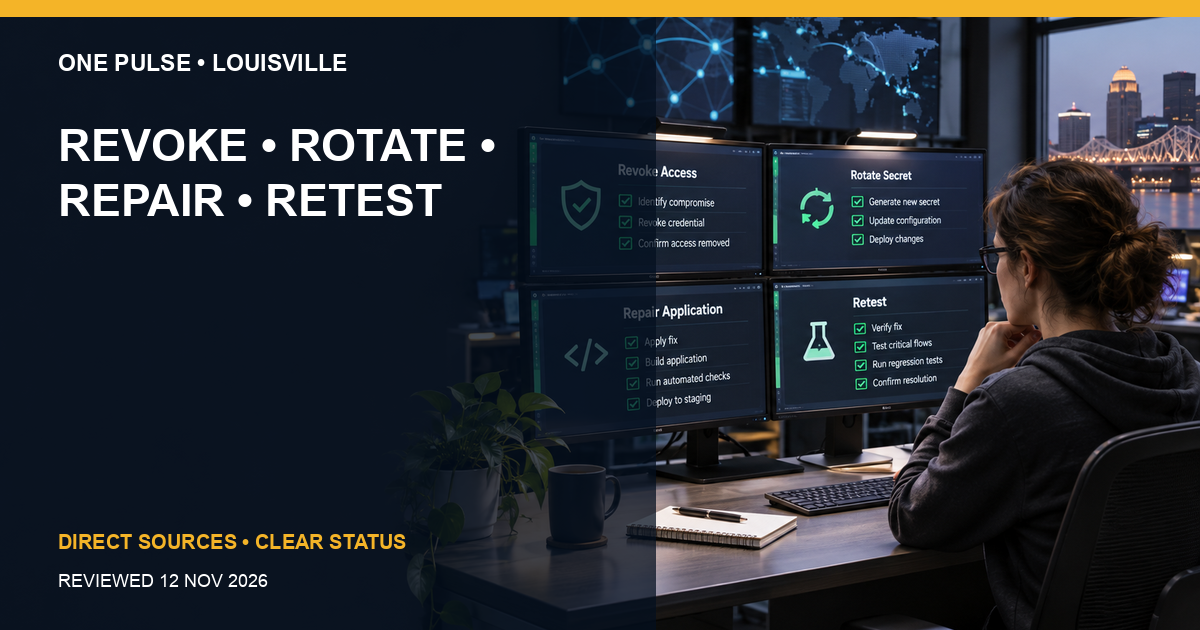
OWASP’s Secrets Management guidance says restarting a service does not revoke a stolen credential and recommends revocation, rotation, removal from the exposed system, dependency repair, and logging.
Seven-state incident ticket
| State | Minimum evidence |
|---|---|
| 1. Authorization | System owner, approved responder, scope, stop/rollback point. |
| 2. Secret identity | Secret class, account/system, privilege and owner—never the value. |
| 3. Exposure | Surface, date/time window, provider retention/deletion status, affected versions. |
| 4. Revoke | Old credential disabled and access sessions/tokens addressed. |
| 5. Rotate | New least-privilege secret created and stored through the approved manager. |
| 6. Repair | Authorized dependencies/configuration updated; exposed copies removed where controllable. |
| 7. Retest/close | Authentication, critical flows, logs and regression checks; residual risk and owner sign-off. |
Reader action
- Contain and revoke first; do not wait for perfect investigation.
- Rotate through the approved secret manager and reduce privilege.
- Repair every known dependency with rollback available.
- Retest, monitor, document, and escalate under the owner’s incident plan.
This is not proof that a provider retained or misused data, not a complete forensic procedure, and not authorization to access third-party systems.
Foundation and source
Public-information notice: This Pulse is a dated, source-linked research summary for general educational use. It reports what cited controlling sources state as of the review date. Citation does not mean endorsement, partnership, certification, or independent confirmation of every assertion. This is not individualized legal, medical, tax, accounting, investment, insurance, cybersecurity, licensing, regulatory, procurement, employment, real-estate, or other professional advice. Rules and facts can change. Verify the controlling source, jurisdiction, effective date, and your own facts before a consequential decision.