
Direct sources. Clear status. Practical public information.
Reviewed November 9, 2026 · defensive software and vulnerability management · NIST SP 800-218 and SP 800-216.
Authorization boundary: Use this method only for software, accounts, devices, applications, data, and networks you own or are explicitly authorized to test. Keep credentials, private logs, production data, personal information, keys, tokens, and sensitive configurations out of public posts and public AI services.
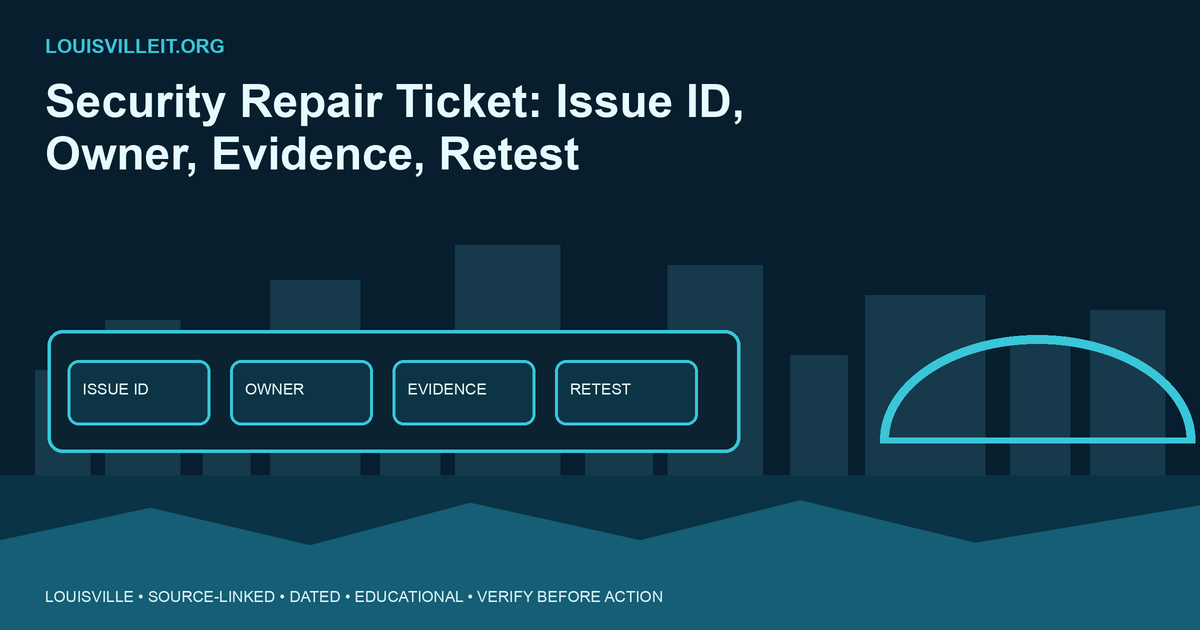
Four fields that turn a finding into controlled work
| Field | Minimum evidence |
|---|---|
| 1. Issue ID | Stable identifier, date found, affected component/version, source of finding, and duplicate relation. |
| 2. Owner and scope | Authorized system owner, repair owner, exact in-scope asset, allowed method, stop condition, due/review date, and human decision gate. |
| 3. Evidence | Safe reproduction using synthetic or minimized data, expected behavior, observed behavior, severity basis, environment, and evidence location. |
| 4. Repair and retest | Chosen response, code/configuration change, review, tests, rollback point, retest result, residual risk, and final disposition. |
Safe AI-assisted workflow
- Give the AI a redacted, synthetic, minimum-necessary description—not live secrets, production records, or target-specific access.
- Ask for hypotheses, test ideas, and possible repairs; treat every output as a proposal.
- Have an authorized human reproduce and scope the issue in an isolated branch, test environment, or deliberately vulnerable learning lab.
- Choose repair, mitigation, acceptance, transfer, or rejection through the responsible human owner; preserve the reason.
- Repair, retest the defined behavior and regression boundary, record evidence, and keep a rollback point.
Mini ticket template
Issue ID:
Authorized owner and exact scope:
Expected safe behavior:
Observed evidence (synthetic/redacted):
Risk basis and human decision:
Repair or mitigation:
Retest and regression result:
Rollback point:
Residual risk / final disposition:
Evidence date and reviewer:
What this does not establish
A ticket does not prove exploitability, severity, legal exposure, complete remediation, system-wide security, compliance, or authorization outside its recorded scope. NIST SP 800-218 is a high-level framework that organizations tailor. NIST SP 800-216 addresses federal vulnerability-disclosure programs; this article adapts record discipline for defensive education and does not make the reader a federal program office or authorize scanning or testing a third party.
Official sources
- NIST SP 800-218 — Secure Software Development Framework 1.1
- NIST SP 800-216 — Federal Vulnerability Disclosure Guidelines
Public-information notice: This Pulse is a dated, source-linked research summary for general educational use. It reports what the cited sources state or what the identified public record shows as of the date reviewed. Citation does not mean endorsement, partnership, certification, or independent confirmation of every third-party assertion. This is not individualized legal, medical, tax, accounting, investment, insurance, cybersecurity, licensing, regulatory, procurement, employment, real-estate, or other professional advice. Rules, facts, availability, and eligibility can change. Verify the controlling source, jurisdiction, effective date, and your own facts, and consult the responsible agency or a qualified professional before a consequential decision. External links are provided for attribution and may change. Use this information and any reader-controlled checklist at your own discretion and risk.