
What Jayden Tran, 12, Can Teach Adults About Building Apps with AI
LouisvilleIT · Young maker spotlight · September 2026
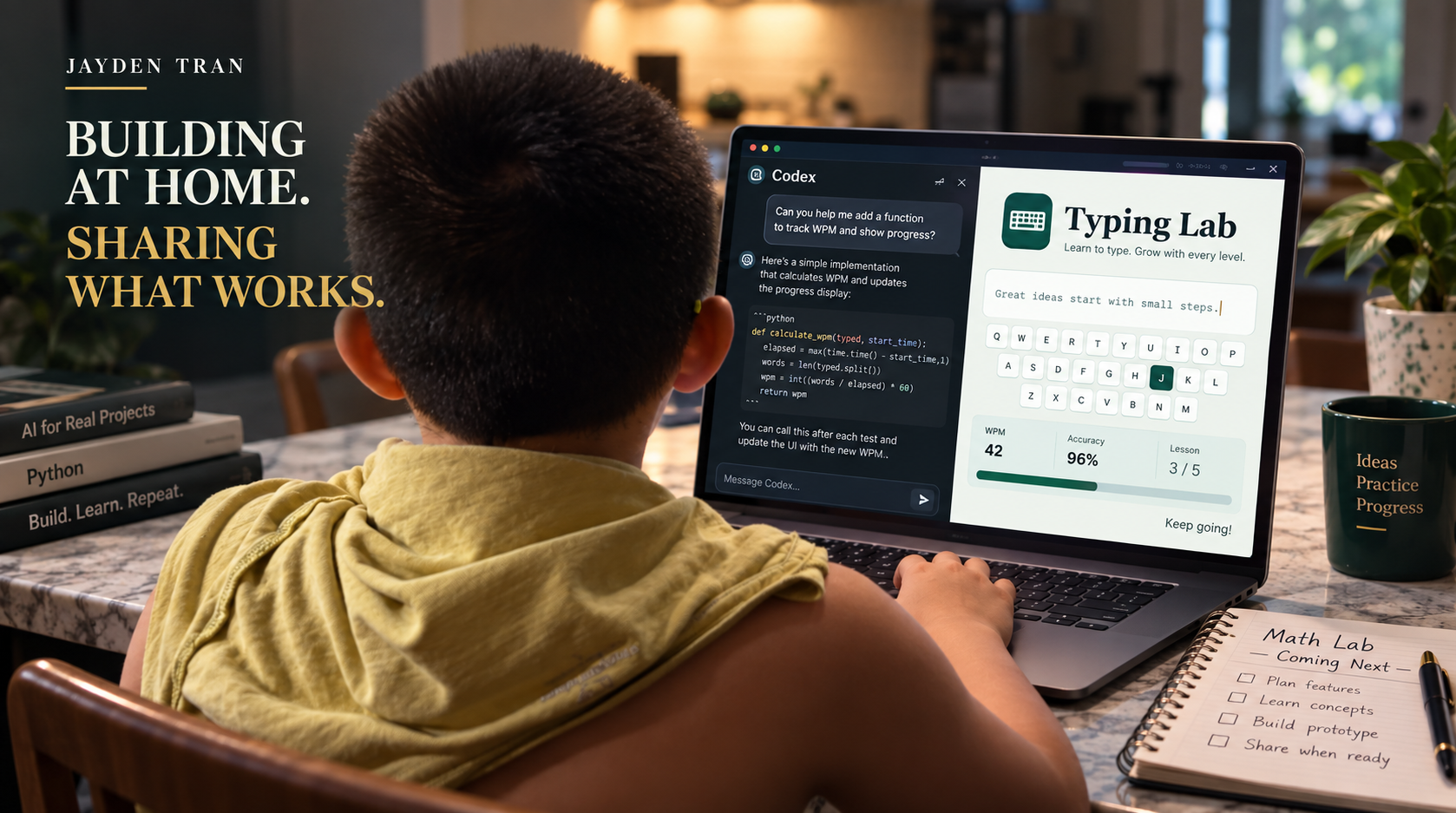
Jayden Tran is 12. At home in Louisville, he has built something people can open and use: Typing Lab. His next idea is a math app. The most important lesson is not that a child has an AI tool. It is that he is willing to ask what should exist, try to build it, see what happens, and improve it.
Editor’s note: the feature image is a conceptual illustration of an AI-assisted workspace, not a screenshot of Jayden’s actual screen.
Jayden wants to make tools and games his friends, cousins, and classmates can use and play together. Typing Lab is the live example today; a math app is a project in development, not a released product. That distinction matters. Real builders tell you what works now and what they are still working on.
What a 12-year-old maker can teach adults
Children are often quick to ask, “Could we make this?” Adults may begin somewhere else: another definition, another certificate, another plan to feel ready. Learning and credentials have value. But they become more powerful when they help you make, test, explain, and improve a real thing.
Jayden’s example is not a claim that every child is a software engineer or that AI replaces engineering. It is a reminder that curiosity can start a serious process. Define the person you want to help. Describe the smallest useful version. Ask an AI assistant for a possible approach. Review what it produces. Test the app yourself and with others. Notice what fails. Ask a more precise question.
That is creative problem-solving. It is also the beginning of software architecture: deciding what the tool must do, what information it needs, where errors might occur, and how a person will know it is working. A beginner can practice those decisions before mastering every programming term.
The loop: ask, build, test, debug, ask again
Who is this for?
Name a real user and one problem. “Help my cousin practice typing for ten minutes” is more useful than “make an amazing education platform.”
Make the smallest version.
Use approachable tools and AI assistance to create one working screen. Learn enough of the code to understand what it does and how to change it.
Watch someone use it.
Does it load? Is it clear? Does progress save appropriately? Can someone use it on a phone? A working demo teaches more than a polished promise.
Find the next question.
When something breaks, describe exactly what happened, what you expected, and how to reproduce it. Fix one issue; test again.
For young makers, this cycle can make math, writing, logic, design, and persistence feel connected to a purpose. A math app, for example, invites questions about levels, feedback, fair scoring, and whether a classmate understands why an answer is right. The learning lives in those decisions—not in collecting screens or generating code for its own sake.
An invitation to adults: show your work
This is a friendly challenge to professionals and absolute beginners alike. If you have studied technology for years, what small useful tool can you demonstrate today? If you have never coded, what problem do you understand well enough to describe? Both starting points belong in the room.
At LouisvilleIT, we want adults to borrow a young maker’s momentum without abandoning adult responsibility. Ask boldly. Build a first version. Learn the underlying concepts as they become relevant. Protect privacy, check accessibility, verify AI-generated output, and involve human judgment before sharing anything consequential.
Start with one week, not an abstract five-year plan: write down a user and a problem; sketch one screen; create a prototype; ask one person to try it; record what broke; make one improvement; then explain what you learned. You will have more than a certificate-shaped intention. You will have evidence of practice.
Your turn to build
Let curiosity become a working app.
Meet Jayden’s live Typing Lab, then try LouisvilleIT’s free App Starter. When you are ready for a guided build-first learning path, tell us the problem you want to solve. No prior AI experience is required to begin asking better questions.
Explore Jayden’s Typing Lab →Try the App Starter →Ask about learning with LouisvilleIT →Typing Lab is a student-built learning project. The math app is forthcoming. AI-assisted development still requires testing, privacy safeguards, and human review. This article is a maker spotlight and an invitation to learn by doing, not a promise of admission, employment, or specific results.